
Animal-Assisted Therapy for Trauma: Why Some Clients Open Up Faster With an Animal in the Room
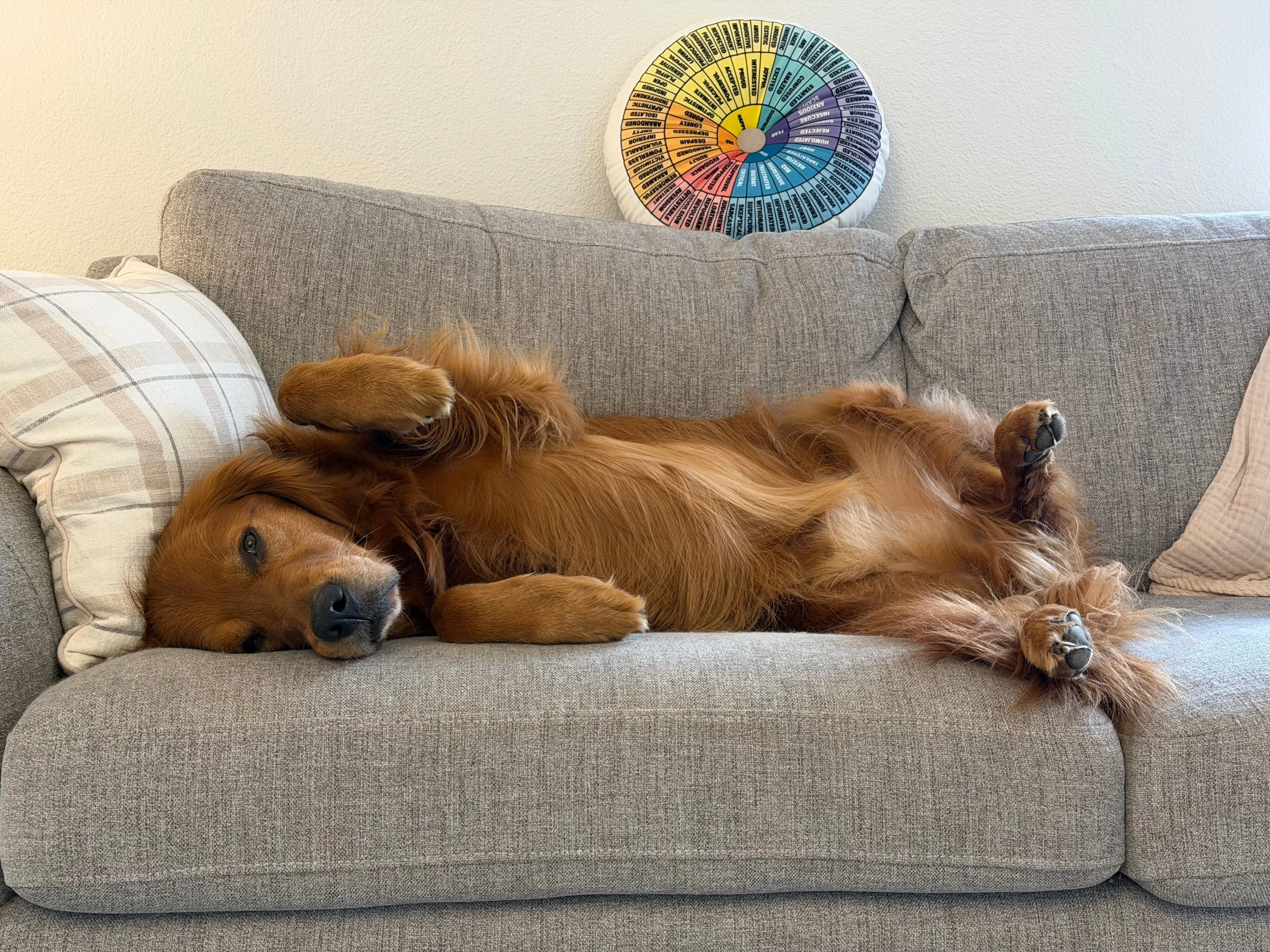
Winston, Lakewood Holistic Counseling’s therapy dog, on the couch with a pillow and emotion wheel
Trauma therapy asks a lot of people. It asks you to talk about things you've spent years trying not to think about, to sit with a therapist you may have only just met, and to automatically trust that the room is actually safe even though your nervous system isn’t fully there yet.
For many clients, that trust takes time to build. But for some, something shifts the moment an animal walks into the room.
How Trauma Disrupts Trust
One of the core challenges of trauma work is that trauma often damages trust. If you were hurt by a person (or hurt in a way that made people, authority, or vulnerability feel dangerous), it makes sense that sitting across from another person (even a caring, trained therapist), can feel activating. Your nervous system doesn't automatically know that this relationship is different from any other relationship.
This is part of why traditional talk therapy can feel so hard to start. Before any processing can happen, a client's body first has to believe the room is safe enough to lower its guard. That can take weeks or months of session after session, simply working to build trust before the deeper work even begins.
Why an Animal Changes the Equation
Therapy Animals offer something a human therapist, no matter how skilled, cannot fully replicate: they are perceived as inherently non-threatening.
A dog or other therapy animal doesn't ask probing questions. It doesn't have a facial expression that might be misread as judgment. It doesn't carry the weight of "authority figure" that a therapist, however warm, still holds in a client's mind (especially for clients whose trauma involved people in positions of power.)
This matters because the nervous system reads safety cues quickly, often before conscious thought catches up. So when a therapy animal is present, many clients describe feeling calmer within minutes. Some examples of what happens when a therapy animal is present include a shift in heart rate, breathing, and body tension that would otherwise take much longer to reach in a traditional therapeutic setting.
Co-Regulation: A Nervous System Shortcut
Part of what's happening here has to do with co-regulation. Co-regulation is the process by which one nervous system helps calm another. Animals, particularly dogs trained for this work, tend to have calm, steady physiological states. Being near a regulated nervous system can help a dysregulated one settle, almost by proximity alone.
This is different from talking through calming techniques or coping skills. A trained therapy animal offers a more direct, embodied experience that the room is safe, which is often exactly what trauma survivors need before they can access the parts of the brain responsible for language, reflection, and processing.
A Focus Outside the Self
There's another quiet benefit to having an animal present: it gives clients something to focus on besides themselves.
Trauma work often requires intense self-focus of noticing internal sensations, naming emotions, revisiting memories. For some clients, especially those who feel exposed or overwhelmed by direct eye contact or sustained attention, having an animal in the room offers a natural place to look, a hand to rest on fur, a small task (like petting or offering a treat) that keeps the body occupied while the harder conversation happens alongside it.
This isn't avoidance- it’s regulation. Many clients find they can go deeper into difficult material precisely because they have this outlet, rather than feeling trapped in a chair with nowhere for their nervous system to discharge tension.
Building the Bridge to the Human Relationship
It's worth noting that the goal of animal-assisted therapy isn't to replace the therapeutic relationship, it's to make that relationship more accessible. Over time, many clients find that the trust they build more quickly with the animal in the room starts to extend to the therapist as well. The animal becomes a kind of bridge, helping the nervous system reach a state of safety that then allows the human connection to deepen too.
Who Tends to Benefit Most
While animal-assisted therapy can support many kinds of clients, it often resonates especially strongly with those who:
Have experienced relational trauma, where trust in people specifically feels difficult
Struggle with hypervigilance or feeling "on guard" in new environments
Find traditional talk therapy overwhelming or too exposing, especially early on
Are children or teens, who often connect more naturally through play and interaction with an animal than through direct conversation
A Different Way In
Trauma therapy doesn't have to start with the hardest conversation in the room. Sometimes, it starts with a dog resting its head on your knee offering you their regulated nervous system.
Curious whether animal-assisted therapy could support your healing? Reach out to schedule your free consultation.