
Trauma Therapy in Lakewood, CO

Do you feel caught between intense anxiety and total exhaustion?
Or does it feel like your body and mind are living in the past, even though a part of you knows you are safe in the present?
What about feelings and thoughts of worthlessness, shame, or being too much?
If the above questions resonate with you, you may be coping with the after effects of a trauma and/or complex trauma.
If you feel like you’re overreacting to small things or under-reacting to big things, please hear this: your reactions make sense and a trained trauma therapist can help.
The ups and downs, negative thoughts and feelings, and reactions are the way the nervous system tries to protect. However, that protection is mentally and physically exhausting. It makes the world feel like too much, your relationships feel fragile, and who you are feel like a stranger.
In our fast-paced society, we are told to "get over it" or "move on." But the human nervous system doesn't work on a calendar. It works on safety. If your body doesn't feel safe, it won't let go of its defenses.
Many people spend years wondering why they can’t "just be happy" or why they keep picking the same types of partners. Often this turns into believing negative things about themself or the world. However, those problems and thoughts can often be tied back to trauma. Recognizing that your symptoms are actually survival strategies is the first step towards healing from trauma.
Whether you have a specific event in your past or a general sense that you’ve had to shrink yourself to survive, you are in the right place- therapy for trauma can help.
Questions about trauma therapy? Reach out today.

Most people experience trauma at some point in their lives
Trauma is often misunderstood. We tend to think of it only as a singular, catastrophic event. While trauma can be one event, trauma can also be a collection of events that occurred over and over again- also known as complex trauma.
Here’s a quick glance at the differences between PTSD and C-PTSD:
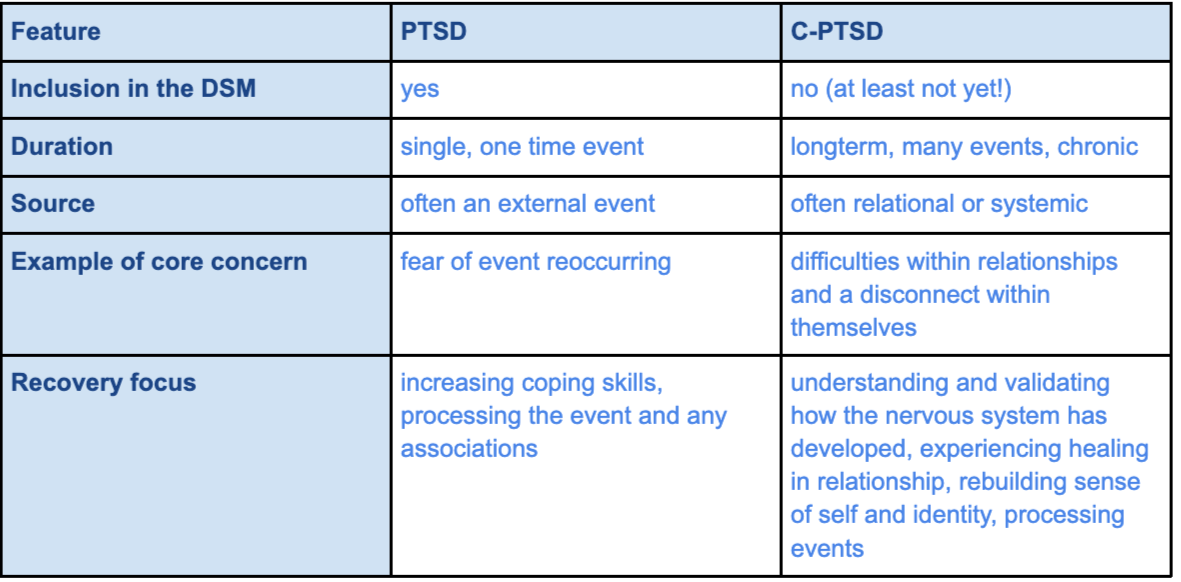
In the clinical sense, PTSD is a short term single event, while C-PTSD is often repeated events that occurred over a longer period of time. Some examples of events that may lead to PTSD are a car accident, a sudden loss, or a single incident of physical assault. Some examples of C-PTSD are growing up with parents who were abusive or neglectful, having your physical and/or emotional needs dismissed by a caregiver, chronic illness, or repeated experiences of bullying.
How do you know if you have experienced trauma?
This is a common question, especially in a world that minimizes pain.
Trauma is not defined by the event itself, but rather what happens inside of you as a result of what happened to you. It is the residue left behind when an experience was too much, too fast, or too soon for your nervous system to process.
So how does trauma show up in the nervous system?
When you experience trauma, whether it was in childhood where your emotional needs were neglected, a sudden loss, a car accident, or a high-control religious environment, your brain moves into survival and therefore shifts your nervous system into protection mode. We do not get to decide how our nervous system tries to protect us. For some it is fight, others flight, freeze, or fawn. More than likely, your nervous system experiences a combination of those protection modes and can get stuck, even once the danger has passed.
What are some examples of fight, flight, freeze, and fawn?
-
Irritability, yelling, self harm, verbally or physically fighting
-
Racing thoughts, suicidal thoughts and/or actions, ghosting, avoiding triggers
-
Spaced out, lack of motivation, feeling physically heavy, feeling disconnected from thoughts, feelings, and sensations
-
Keeping the peace, prioritizing other people, avoiding conflict
The good news is, with the help of a clinically trained and licensed trauma therapist, you can recover. You can feel hope. You can feel grounded. You can find a way to thrive.
Whether the trauma happened last week or many decades ago, a trauma informed and trained therapist can help.

So, what are trauma therapy sessions like?
In my practice, we don't just talk about the past; we work with the way the past is showing up in your body, your relationships, and your sense of self.
Through a combination of relational care and nervous-system-informed therapy like EMDR, AEDP, and Animal Assisted Therapy, we create a space where you can finally stop shrinking, start breathing, and begin to feel at ease in your mind and body.
The solution isn't a "quick fix" or a 10-step checklist. Real, lasting healing from trauma and complex trauma requires a relational approach with a trained therapist.
Because many traumas happen within relationships (or in the absence of a supportive one), the healing must also happen within a relationship. My approach to trauma therapy and complex trauma therapy at Lakewood Holistic Counseling focuses on Long-Term Relational Care. Together, you and I co-create a therapeutic relationship that serves as a secure base.
From this safe space, we can slowly begin to untangle events from the past and how they intersect with the present. We move at the speed of your nervous system, ensuring you never feel pushed beyond what you can handle.
EMDR, Relational and Attachment Based Therapy, and Animal Assisted Therapy for Trauma Recovery
Moving at the speed of your nervous system looks like being present with a physical sensation, an emotion, or a thought. Other times it might look like reprocessing the traumatic memory that is tied to the sensation through EMDR. Additionally, it may look like grounding through use of Animal Assisted Therapy or using a guided mindfulness resource. In the therapy room, I focus on attuning to you and your needs in the present moment while providing the appropriate intervention, which over time leads to trauma recovery.
How do we actually move the past out of the present? I utilize evidence based and relational therapy approaches that have been shown to provide relief for trauma.
EMDR
Think of your brain like a filing cabinet. Trauma is like a file that got jammed in the drawer; it’s stuck, and every time you try to close the drawer, it hits that file. EMDR helps reprocess that file so it can be stored correctly in the past, where it belongs. It reduces the emotional charge of the memory so your body stops reacting as if it’s happening right now.
Relational and Attachment Based Therapy
This modality is about undoing aloneness. We work in the present moment to notice what is happening in your body and heart right now. By staying with your emotions in a safe relationship, we actually transform your neural pathways, moving from protection to flourishing.
Animal Assisted Therapy with Winston the therapy dog
Often times for survivors of trauma, people can feel unsafe, a dog can help bridge that gap. Winston provides safe, gentle attunement and a calming sensory experience. He stays with you in the present and is a caring, non-judgmental being.
Perhaps You’re Considering Trauma Therapy But Still Have Concerns…
-
No. In fact, venting or reliving every detail can sometimes be re-traumatizing. We focus on how the trauma is affecting you now. We only go into the details of the past when your nervous system feels regulated and ready.
-
Because I specialize in long-term relational care, I do not put a deadline on your healing. It also does not mean that you will be in therapy for the rest of your life. Think of it this way- a paper cut can take 2-3 days to heal and a full week for the skin to mend- and that is just a surface level paper cut. Trauma goes deeper and impacts many aspects of our lives- this takes time and we work at a pace that ensures the changes we make actually stick.

Healing from trauma is possible
If you are struggling with anxiety, a sense of disconnect from yourself or relationships, or replaying a traumatic event over and over again- therapy for trauma can help you to regain that sense of calm, feel connected to yourself, and decrease the power that trauma holds. When you are ready, as a starting point to connect, I invite you to fill out the contact form for a free 20 minute consultation.
Recent blog posts on trauma therapy